



|
Contact |
Rudolf Geigy (1902–1995)Born of a Wealthy Family |
|
Rudolf Geigy was born into a wealthy industrial family in Basel. The Geigys belonged to Basel's economic and political elite. Their name is closely connected to the pharmaceutical firm, J. R. Geigy AG, that revolutionised the fight against tropical diseases with the invention of DDT in 1939. Rudolf Geigy opted out of a professional career within the family-owned firm, though he was a member of the governing body for almost 40 years. |
|
Contact |
Rudolf Geigy (1902–1995)Man of Science |
|
Geigy studied zoology in Basel under Friedrich Zschokke. Later, he joined Emile Guyénot in Geneva and became more interested in physiology. In 1931, Geigy published his PhD research and became well-known internationally. |
|
Contact |
Rudolf Geigy (1902–1995)Director of the Swiss Tropical Institute |
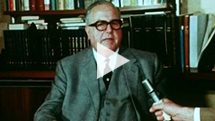 |
In 1943, Geigy became the first director of the Swiss Tropical Institute, which he subsequently led for almost forty years. In this position, new possibilities for scientific research opened up and Geigy developed an interest in studying the pathogens and vectors present in the transmission of tropical diseases. Quote from: „Vom Vordringen ins Undurchdringliche" "There, nature poses the scientist and the doctor with many riddles that do not exist here; thus, you must acknowledge that science still has a lot to do. Many things still need to be discovered and considered in order to protect people living in the tropics from infectious diseases. Such is the aim of the Swiss Tropical Institute. In our laboratories, for example, we can study the life and behaviour of insects, learn the ways in which they constitute a hazard to humans, how they are invaded by pathogens and how they, in turn, transmit those pathogens to humans. In a scientific laboratory, you can study those processes day by day. And if you, by chance, have found a promising way to curb the influence of the pathogen, then you have to check whether or not your strategy would also work in the field. These activities are, indeed, very satisfying for our researchers as Switzerland has always played a leading role in helping and healing others." (Rudolf Geigy, «Tropische Quälgeister», Schulfunksendung vom 21.06.1946) |
|
Contact |
Rudolf Geigy (1902–1995)The Animal Lover |
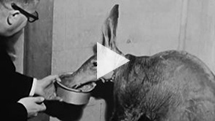 |
Geigy was a strong supporter of the Basel Zoo. As the president of the board of governors, he played an important role in extending and reorganising the site. Geigy never shied away from supporting new projects with his own money if he considered it necessary and the animals were always his central interest. Geigy not only introduced new concepts of animal welfare but he also fostered animal behaviour research.
Mister Geigy and Misses Pori |
|
Contact |
Rudolf Geigy (1902–1995)The Conservationist |
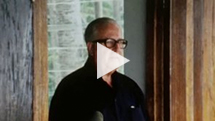 Extracts of «Protected nature on Cousin Island, Seychelles» (1975) |
Geigy was deeply involved in protecting nature. He founded the "Hilfsfonds für die Vogelwarte Sempach", developing the ornithological station into an internationally renowned research institution. Geigy also supported the initiatives of the World Wildlife Fund (WWF). Two projects in particular were near to his heart: the rhino-conservation project on Java, as well as an ornithological station on Cousine Island in the Seychelles. Without further ado, Geigy purchased this natural paradise in order to preserve it for future generations. "If we attempt to protect our earth, then we have to be aware of the beauty of our life-generating planet. What a variety of animals and plants it displays! Its infinitely varied blueprint, its physiology down to the single cell with the astonishingly working organelle-system, they constantly provide us stimulation for future research." (Rudolf Geigy, Erforschung der Natur im Feld und Laboratorium, in: Verhandlungen der Schweizerischen Naturforschenden Gesellschaft (wissenschaftlicher Teil), 150. Jahresversammlung in Basel, S. 9–20, 1970) |
|
Contact |
Rudolf Geigy (1902–1995)The Frog King |
|
Geigy had a preference for rounded shapes. Elephants, hippos, warthogs and the somehow more modest toad were like fixed stars in his intellectual cosmos. |
|
Contact |
Rudolf Geigy (1902–1995)The Humanist |
|
In 1945, Geigy and his team chartered an airplane that took them to West Africa. There, they installed their tentative field-laboratories and introduced themselves to the scientific communities working in the French and Belgian colonies. One of the expeditions' highlights was visiting Albert Schweitzer's famous bush hospital in Lambarene. Geigy consciously followed the tradition of medical humanists and in so doing he signaled an important characteristic f the still young tropical institute. |
|
Contact |
Rudolf Geigy (1902–1995)The Networker |
|
Rudolf Geigy actively forged close scientific ties to European and African researchers. The good relationship between Swiss and French scientists resulted in the creation of the Centre Suisse de Recherches Scientifiques (CSRS) in Côte d'Ivoire in 1951. Geigy encouraged many Swiss STI-scientists to work at the CSRS where they dealt with zoology, nutrition, conservation or agronomy. Later, medical research and public health topics became more relevant. Today, the Swiss Tropical and Public Health Institute (Swiss TPH), as it is now known, is an important partner of the CSRS. The CSRS has developed into an important research and implementation centre not only for Côte d'Ivoire but for the whole region. |
|
Contact |
Rudolf Geigy (1902–1995)The Field-Worker |
|
The Swiss Tropical Institute Field Laboratory (STIFL) in Ifakara, Tanzania was a hotspot of Swiss science overseas. Tanzania became a second home for Geigy and the Swiss Tropical Institute. There, the most important tropical diseases could be studied: malaria, sleeping sickness, relapsing fever or river blindness. Over the years, STIFL developed into one of the most important research institutes in Africa. Step by step, it was integrated into the Tanzanian health system and turned into a trust in 1996. Today, the Ifakara Health Institute (as the former STIFL is called today) is present throughout the country and has a big role in fighting against infectious and chronic diseases and in strengthening the Tanzanian health system. |
|
Contact |
Rudolf Geigy (1902–1995)Mister Warthog – "Bwana Ngiri" |
|
Geigy's acquired the nickname "Bwana Ngiri" – Mister Warthog – what at first sight seems quite unflattering became a brand name and part of Geigy's identity. Intrigued by the question of whether or not warthogs constitute a reservoir for African relapsing fever, Geigy had driven many animals out of their holes and later scientifically examined. The hypothesis could not be verified but the nickname, however, remained. |
|
Contact |
Rudolf Geigy (1902–1995)The Hunter |
| Geigy loved to hunt. He hunted buffalos and other residents of the African steppe from a respectable distance. "... and all of a sudden I see a young bull, whom the land-rover has separated from his herd without me recognising, standing in the field. I climb on the engine hood and we approach the bull and soon after he collapses, hit by a clean shot to the heart." (Rudolf Geigy, Vom Vordringen ins Undurchdringliche, 1967) |
|
Contact |
Rudolf Geigy (1902–1995)The Vice-Chancellor of the University of Basel |
|
Once back in Basel, Geigy got a lectureship for experimental embryology and genetics at the University of Basel. Three years later, he became an assistant professor and then a full professor in 1952. The highlight of his university career was becoming the universities' vice-chancellor in 1962. In his inauguration speech as a vice-chancellor, entitled "Leap into Self-Reliance", he portrayed African decolonisation as an unfolding process that cannot be stopped. His response to it was unambiguous: development aid.
Inauguration speech R. Geigy, 1962 „Leap into Self-Reliance“ |
|
Contact |
Rudolf Geigy (1902–1995)The Development Worker |
|
Development aid was Rudolf Geigy's response to Tanzania's independence in 1961. His vision: to strengthen the middle class and train young health personnel "on the spot". Already in 1960, Geigy had created the "Basel Foundation for the Aid of Developing Countries", bringing together five Basel-based pharmaceutical companies. The foundation supported the Rural Aid Centre (RAC) in Ifakara that trained Tanzanian "barefoot doctors". Situated near the mission-led St. Francis hospital and STI's field-laboratory, the RAC was a unique training site for medical personnel. Ifakara proved that combining research training and services could be successfully implemented in rural Africa. Geigy's vision endured: even today, training features prominently in Ifakara. The Tanzanian Training Center for International Health (TTCIH), supported by the Novartis Foundation, recalls Geigy's early initiative.
"It is now necessary to create something like an intellectual middle class, because a modern and solid nation needs thousands of specialised heads and hands." S. 18–19 (Rudolf Geigy, «Der Sprung in die Selbständigkeit. Entwicklungshilfe und Menschheitsproblem» Rektoratsrede gehalten an der Jahresfeier der Universität Basel am 23. November 1962) |
|
Contact |
Rudolf Geigy (1902–1995)The Crime-Fiction Author |
|
The Cold War. The world divided into blocs. Spying. That's the backdrop for the thriller "Siri. Top secret". A yellow envelope of unknown content changes hands. Will it fall to the Russians? Or even to the Chinese? How Geigy found time to write detective stories remains unanswered by this novel. Other questions, too remain open... |